
How to Make Your Speaking More Automatic in Four Weeks
A science-based practice system with 20 exercises and a printable PDF workbook

In this week’s free article and accompanying video, I showed you how to create a three-minute speaking baseline and compare it with a second recording four weeks later.

This paid follow-up focuses on what to practise in between, so that the final comparison reflects real development rather than four weeks of vague, unfocused speaking.
By the end, you will know how to choose speaking exercises according to the problem you actually need to solve, organise short and focused practice sessions, use repetition effectively, introduce time pressure without sacrificing clarity, and turn feedback into a better second attempt.
At the end of the article, you will also find a 20-page PDF workbook containing the full collection of exercises, weekly plans, speaking prompts, and tracking pages.
“Speak more” is common advice. It is also incomplete. It resembles telling someone to become a better pianist by spending more time near a piano.
Should the pianist practise scales, repeat a difficult passage, work on rhythm, sight-read unfamiliar music, or perform in front of another person? Each activity develops a different part of the skill.
Speaking practice works in much the same way.
Speaking is several problems hiding inside one word
Learners often lump all forms of oral production into a single category called speaking practice.
They answer questions from a tutor, repeat phrases from an app, describe their weekend, shadow a podcast, record a monologue, or talk to themselves while cooking.
All these activities involve speaking. They do very different cognitive work.
Repeating a dialogue strengthens access to familiar language. Describing a picture reduces the burden of inventing content because the scene is already visible. An opinion task requires organisation and argument. A role-play introduces social pressure. An information-gap task forces clarification because one person possesses information the other person needs.
No single activity develops every part of speaking.
A good four-week system therefore needs variety, although random variety is insufficient. Every exercise should have a clear purpose.
I organise the practice in this programme around five connected capacities.
Faster retrieval
Familiar words, phrases, and grammatical patterns need to become easier to access.Connected answers
You need to move beyond isolated sentences and develop explanations, stories, comparisons, and opinions.Fluency under time pressure
You need practice retrieving and organising language while time is limited.Repair and recovery
You need ways to continue when a word disappears, a sentence fails, or another person misunderstands you.Clarity under cognitive load
Your pronunciation and message need to remain understandable while you are also thinking about vocabulary, grammar, content, and interaction.
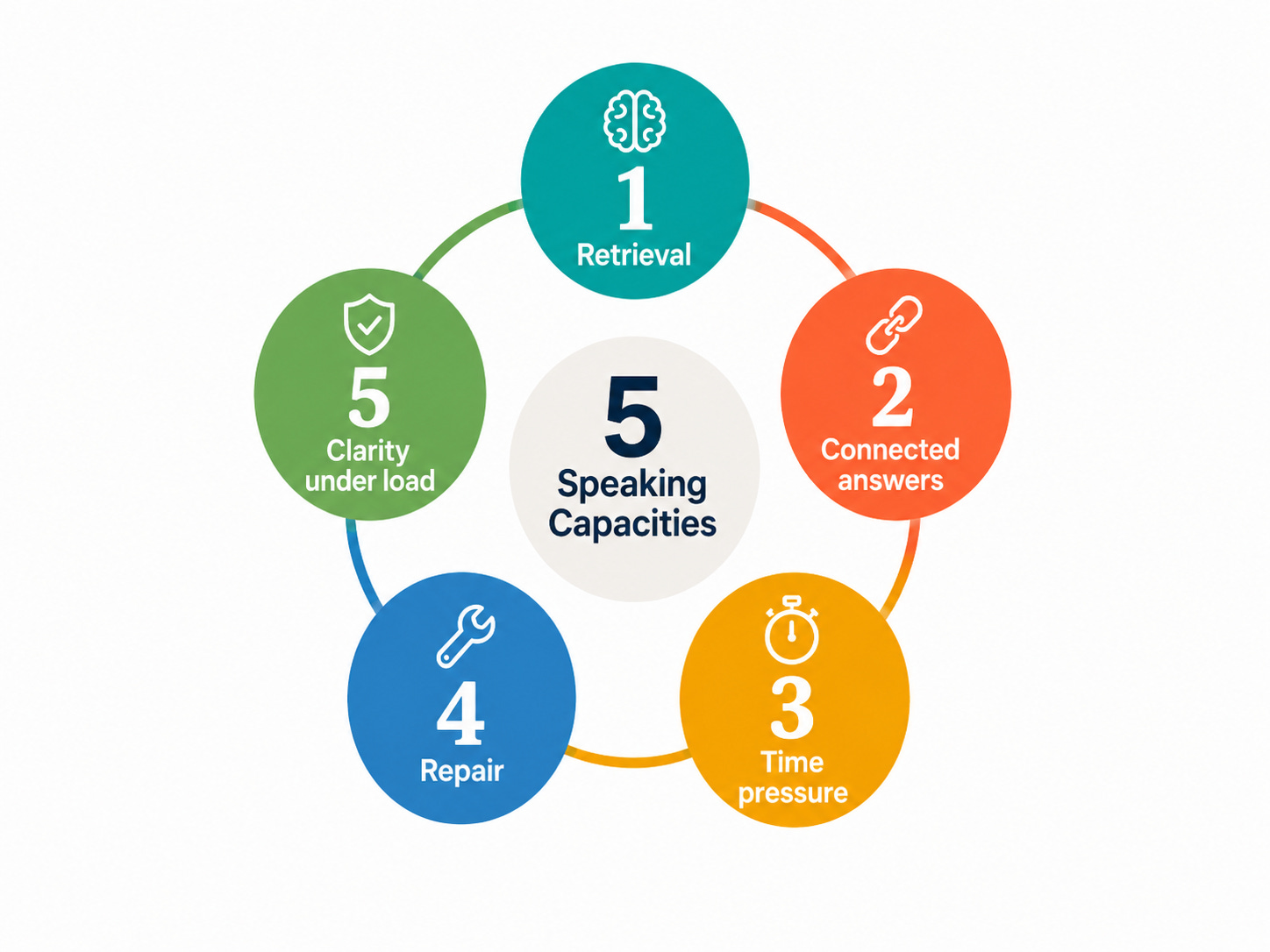
The twenty exercises in the accompanying PDF workbook are organised around these five areas.
What the practice is trying to change
As you might have noticed, I often use the following equation as a practical way of thinking about fluency.
Fluency = Communicative Knowledge × Automaticity ÷ Cognitive Load
This is a working model rather than a literal mathematical law.
Communicative knowledge supplies the material. It includes vocabulary, grammar, pronunciation, collocations, formulaic expressions, discourse patterns, and strategies for managing communication problems.
Automaticity affects access. You may understand the phrase I would rather immediately when you see it on a page and still need several seconds to retrieve it in conversation. Through repeated use, familiar language can become faster and less dependent on conscious construction (Segalowitz, 2010).
Cognitive load includes everything competing for your attention while you speak. You choose an idea, retrieve words, construct the grammar, pronounce the sentence, monitor accuracy, observe the listener, and plan what comes next.
When too many of these processes demand attention at once, even a familiar sentence can feel difficult.
A well-designed exercise deliberately changes the load. It may provide a picture, a familiar topic, a model, several keywords, or preparation time. Later, part of that support is removed.
This is how we move from controlled practice towards more independent speech.
Every article I publish draws on my expertise in second language acquisition and a lifetime of learning and teaching languages. I turn that knowledge and research into clear, practical systems you can use immediately. Upgrade to paid to support my work and unlock the full library of articles, guides, and resources. Thank you!
If this felt useful, feel free to share the post and publication with someone who might need it too.
