
Why Your Flashcards Aren’t Working (And It Has Nothing to Do With Anki)
The science behind flashcards that make vocabulary last.

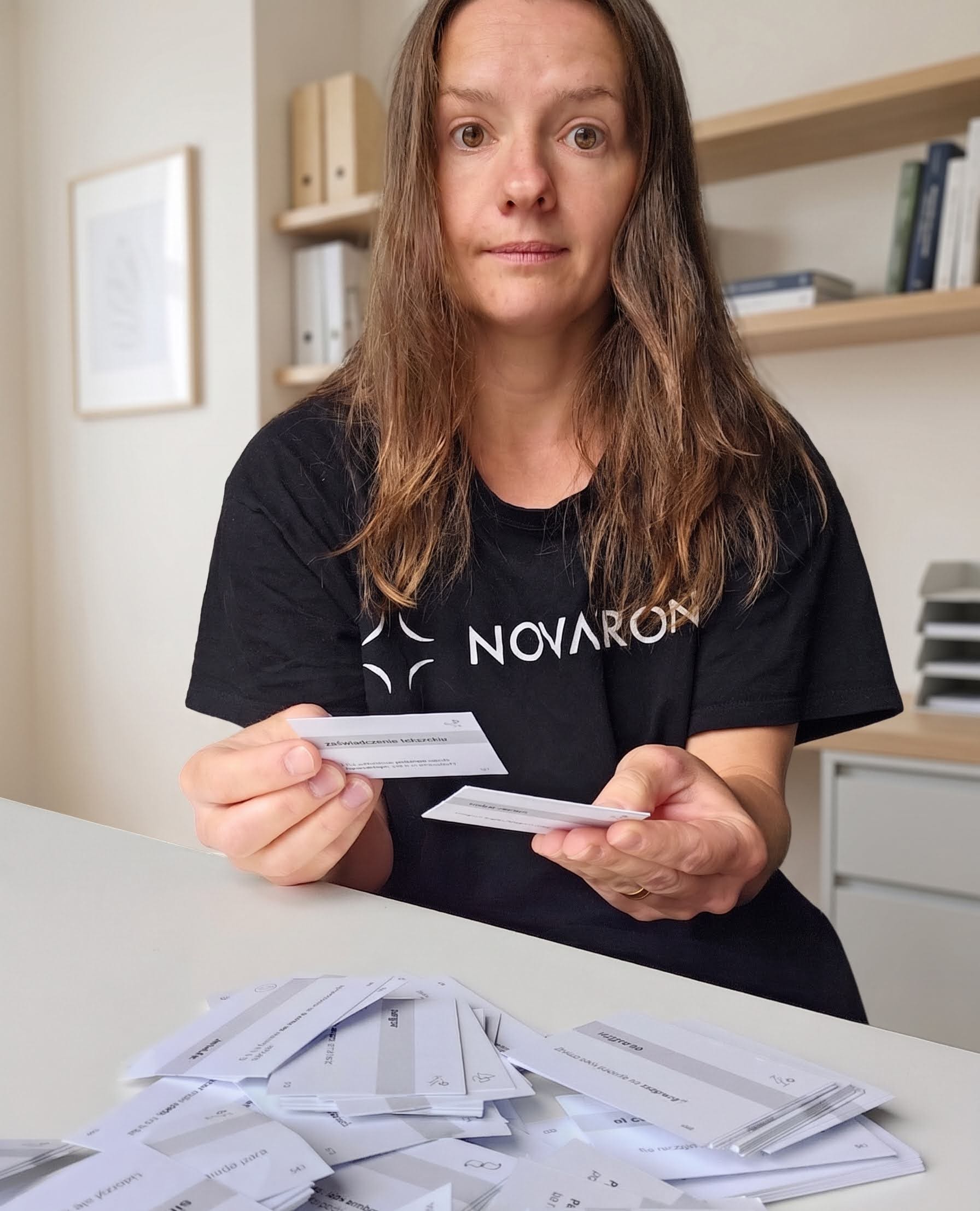
A photo of me with flashcards
A few weeks ago, I restarted Italian after a very long break.
Thanks to my knowledge of Spanish, many words felt familiar. During the lesson, I understood them. During the exercises, I remembered them. When I reviewed my notes later that day, everything seemed to be moving in the right direction.
A few days later, some of those words were already harder to recall.
That was the moment I realized it was time to start making flashcards for the new Italian words I was learning.
And that experience reminded me of a question I hear surprisingly often from language learners.
“I know flashcards are useful. I know spaced repetition works. But how do I actually make good flashcards?”
Most learners have heard the same advice countless times. Use Anki, review regularly, trust spaced repetition, make vocabulary cards.
Yet when they sit down to create those cards, the advice suddenly becomes much less clear.
Which words deserve a card?
What exactly should go on the front?
What should go on the back?
Should you translate, draw, add a sentence, record audio, or write a personal example?
Should you use Anki, Quizlet, paper cards, or a mix of different tools?
How do you stop your deck from becoming a random pile of words?
Underneath all of these smaller questions sits the real one:
I am trying to build a vocabulary system with my flashcards, but where do I start?
Without a clear answer, many learners end up using exactly the same format.
A word on one side.
A translation on the other.
Then another word.
Then another.
Then another.
There is nothing wrong with this kind of flashcard. It can be a useful starting point, especially when you are building an initial vocabulary foundation. The difficulty appears when this becomes the only type of card you ever create.
This month, while preparing personalized learning plans for my Founding Members, I began to notice a pattern. Many learners had accumulated hundreds or even thousands of flashcards over the years. New vocabulary came from books, apps, lessons, podcasts, YouTube videos, coursebooks, and random internet searches. Almost everything was saved.
Very little was filtered.
Very little was prioritized.
Many learners felt overwhelmed by the size of their collections. Some were unsure which words deserved their attention. Others spent so much time adding vocabulary that reviewing it became increasingly difficult.
And then came the frustration.
Words that had been reviewed multiple times still seemed slippery. They could be recognized in one context and forgotten in another. Familiar vocabulary often felt much less reliable than expected.
The more examples I saw, the more convinced I became that many learners were focusing on the wrong part of the problem.
Most discussions about flashcards revolve around tools.
Should you use Anki?
Should you use Quizlet?
Should you use paper cards?
Should you review every day?
Those questions matter. Yet they often hide the deeper issue.
A flashcard is not just a card.
It is a prompt that asks your brain to perform a specific mental action.
The way you design it determines what your brain has to do: recognize a word, retrieve it, hear it, pronounce it, place it in context, connect it to other words, or use it in a sentence.
The term “flashcard” sounds as if it describes a single technique.
In reality, it covers a large family of learning tools. A translation card, a picture card, a pronunciation card, a vocabulary map, an audio card, and a sentence-completion card may all belong in the same deck, but they train different aspects of vocabulary memory.
Some strengthen recognition.
Some strengthen recall.
Some help build connections between related words.
Others use images, sound, context, personal experience, or semantic networks to make information easier to retrieve later.
Understanding these differences can change the way you approach vocabulary learning.
Why vocabulary deserves this much attention
Vocabulary is one of the greatest assets you can build in a language.
It feeds every other skill.
Reading becomes easier when you know more words. Listening becomes less exhausting when familiar vocabulary begins to stand out in the stream of speech. Speaking and writing become richer when you have more language available to retrieve.
There is no magic chip we can insert into the brain with a fully preloaded vocabulary list. Maybe one day. For now, we work with memory, attention, repetition, sound, image, context, and meaning.
This is why flashcards are worth taking seriously.
They are small, simple tools, but they sit at the center of something much larger: how we notice words, remember them, reconnect with them, and eventually use them.
A weak flashcard system can turn vocabulary learning into a storage problem.
A better system can turn vocabulary into something you actively build.
In this article, we’ll explore:
• why traditional word-and-translation cards are useful but limited
• why vocabulary collections often become overwhelming
• what recent research tells us about memory and vocabulary retention
• why different flashcard designs train different kinds of recall
• how to start thinking about flashcards as memory tools rather than vocabulary storage
Later this week, my paid subscribers will receive the practical companion to this article.
I’ll share the complete flashcard system I recommend, including dozens of flashcard formats designed for different learning goals. We’ll look at recognition cards, recall cards, vocabulary maps, pronunciation cards, audio flashcards, context-rich cards, handwritten examples, color-coding systems, review strategies, and several approaches that go far beyond placing a word on one side and a translation on the other.
My goal is simple. By the end of that guide, you’ll have a toolbox rather than a single technique and a much clearer understanding of which flashcard designs are worth your time.
For now, let’s start with a more fundamental question.
Why do some words stay with us while others seem to disappear no matter how many times we review them?
Every article and PDF guide here takes weeks of research, writing, and rewriting to turn dense science into something clear you can use tonight. I’m one person doing this work with care. Upgrade to paid for full access to everything I create and to help me keep building it.
Why Do Some Words Stay While Others Disappear?
Most language learners have experienced the same puzzling situation.
You encounter a new word. You study it. You review it several times. You feel reasonably confident that you know it.
A week later, the word seems much harder to find.
Meanwhile, another word that received far less attention remains firmly in memory.
At first glance, this can feel random.
Research suggests otherwise.
Several factors appear to influence whether vocabulary remains accessible or gradually fades.
Your Brain Learns More From Retrieval Than Review
Imagine two learners studying the Italian word ghiaccio [ice].
The first learner reads the word ten times.
The second learner repeatedly covers the answer and tries to recall it from memory.
Which learner is more likely to remember the word next week?
Research on retrieval practice consistently favors the second approach (Roediger & Karpicke, 2006; Karpicke & Blunt, 2011).
The act of searching memory appears to strengthen memory itself.
This helps explain why vocabulary can feel familiar when you see it yet remain difficult to retrieve on your own.
This is not only a laboratory finding. Kang, Gollan, and Pashler (2013) tested it with real foreign vocabulary. One group repeated new words after a native speaker. Another group tried to produce each word from memory before hearing it. Days later, the learners who had retrieved understood more and produced more, with no loss in pronunciation. Repeating felt easier in the moment. Retrieving taught more.
Recognition and Recall Are Different Skills
One reason learners become frustrated with flashcards is that they mistake recognition for recall.
Recognizing a word in a text is relatively easy.
Retrieving it without support is a different challenge.
This distinction becomes especially important when designing flashcards. A card that trains recognition may be useful for reading. A card that trains recall may be better when you want vocabulary to become more readily available.
Terai, Yamashita, and Pasich (2021) showed that the direction of learning can influence vocabulary outcomes. In their study, lower-proficiency learners benefited more from L2-to-L1 retrieval, while higher-proficiency learners benefited more from L1-to-L2 retrieval (L1 = native language, L2 = second language).
In plain language, the direction of the flashcard matters.
Seeing ghiaccio and remembering “ice” is one task.
Seeing “ice” and retrieving ghiaccio is another.
This is the real reason so many decks fail their owners.
Look at how most of them are built. A word on the front, a translation on the back. Hundreds of cards, sometimes thousands, almost all the same shape. Every one of them a recognition card.
So the review feels productive. The word appears, you recognize it, you move on, satisfied.
Then the support disappears. You are in a conversation or facing a blank page, and the word that felt so familiar a moment ago will not come.
The deck trained the wrong skill.
That is why your flashcards are not working. The fault was never in Anki or Quizlet. It was in the card itself, the same recognition card copied a thousand times.
Fix that one thing, build cards that make you retrieve, and you are already halfway there. Everything that follows is about making those memories last.
Timing Matters More Than Most People Think
Many learners review new vocabulary several times during a single study session and then leave it untouched for days or weeks.
Memory tends to respond better to distributed practice.
A meta-analysis of second-language learning studies found clear advantages of spacing reviews over time rather than concentrating them into a single session (Kasprowicz, Marsden, & Sephton, 2022).
This is one reason why spaced-repetition systems have become so popular.
The timing of the review matters. More recent work treats repetition, retrieval, and spacing not as three separate tricks but as three parts of the same underlying process (Rogers, 2025).
Still, timing alone cannot rescue a poorly designed deck. If you are reviewing thousands of randomly collected words with weak or repetitive cards, spaced repetition may simply help you revisit the same confusion more efficiently.
The Brain Likes Multiple Pathways
Consider these two flashcards.
Card A teaches one connection.
dog equals perro
Card B teaches the same word with a picture of a dog, audio pronunciation, an example sentence, and a small personal note.
Both cards teach the same vocabulary item.
The second card provides more routes back to the answer. An image might help. A sound might help. The sentence may help. The personal note may give the word additional meaning.
Recent research on multimedia vocabulary learning suggests that combining verbal and visual information can support vocabulary learning and retention (Mahdi, Mohsen, & Almanea, 2024; Teng, 2023).
This does not mean every card should become crowded with pictures, colors, audio, and long notes. Too much information can create its own mess.
The point is more practical.
If a word matters, give your brain more than one way to find it.
Words Live Inside Networks
Many learners treat vocabulary as if it were a giant shopping list.
You encounter a new word, write it down, memorize the translation, and move on to the next item.
The brain appears to organize language in a much richer way.
When you hear the word apple, you do not simply retrieve a single definition. Related ideas become active as well. You may think of fruit, red, sweet, tree, juice, pie, or other fruits such as pears and bananas.
Researchers in cognitive linguistics go one step further. Much of a word’s network is built from metaphor and the small leaps of association we make without noticing, which is why showing learners the logic behind a group of expressions helps those words stick better than learning each one in isolation (Littlemore, 2023).
This has important implications for flashcards.
A card that teaches a single word can be useful. A card that helps you build connections between related words may be even more powerful.
This is one reason why category cards, synonym cards, antonym cards, word-family cards, and vocabulary maps can be so effective. They help transform vocabulary from a list into a network.
Recently, while thinking about flashcard design, I found myself sketching a simple vocabulary map on the back of a card.
The front asked me to recall words from a category.
The back organized the answers as a small map of related vocabulary.
Suddenly, the card was no longer testing a single word. It was activating an entire semantic field.
We’ll return to this idea in the practical guide later this week.
Words Rarely Travel Alone
Another common habit among language learners is collecting individual words.
There is an understandable logic behind this. Dictionaries are organized by individual words. Vocabulary lists are organized by individual words. Flashcards often focus on individual words.
Real language works differently.
Words tend to appear alongside other words.
Native speakers retrieve phrases, chunks, collocations, and familiar patterns.
Consider the difference between learning the word decision and learning the phrase make a decision.
Or learning the word heavy and learning the phrase heavy rain.
The phrase immediately provides context, usage, and a stronger clue about how the word behaves in real language.
Research on vocabulary learning suggests that context and repeated meaningful encounters can support vocabulary knowledge over time (Rice & Tokowicz, 2020; Webb, Uchihara, & Yanagisawa, 2023).
This helps explain why many experienced language learners eventually move toward sentence mining, dialogue cards, collocation cards, and example-based flashcards.
The word becomes attached to a situation.
And situations are often easier to remember than isolated definitions.
Creating Beats Copying
Think about the vocabulary you remember best.
Chances are that at least some of it comes from personal experience.
Perhaps you used the word in a conversation.
Perhaps you made a mistake with it.
Perhaps you wrote a sentence that made you laugh.
Perhaps it became connected to a story, a trip, or a memorable moment.
Researchers have long discussed the generation effect, the finding that information generated by learners is often remembered better than information simply received (Slamecka & Graf, 1978).
This connects to an older and deeper idea in memory research. Craik and Lockhart (1972) argued that we remember information in proportion to how deeply we process it. A word we only glance at leaves a faint trace. A word we work with, question, and connect to something of our own leaves a far stronger one. Creating your own card is one of the simplest ways to push yourself toward that deeper processing.
This principle appears in many areas of learning.
A student who writes their own example sentence often remembers it better than a student who copies an example from a textbook.
A learner who draws a small sketch may remember it better than someone who simply looks at a picture.
A learner who records their own voice may engage with the vocabulary more deeply than someone who only reads the word silently.
The common theme is active involvement.
Learning becomes stronger when we participate in the process.
This is one reason I still enjoy handwritten flashcards.
I use digital tools as well, especially when I want spaced repetition and audio support. Yet there is something valuable about physically writing a word, deciding what information belongs on the card, adding a small drawing, highlighting a pattern, or creating a personal example.
The card becomes more than a storage device.
It becomes a small act of thinking.
And perhaps that is the most important idea in this entire article.
The most effective flashcards are those that encourage the kind of mental work that strengthens memory.
Notice what these principles share.
Retrieving a word instead of rereading it. Spacing your reviews instead of piling them into one evening. Processing a word deeply instead of letting your eyes slide across it. Each one is a way to build a memory that lasts, rather than one that fades within the week. That is what we are really after. Not knowing a word tonight, but still having it months from now, when you need it in a real sentence.
Once you understand that principle, a very interesting question emerges.
If different flashcards train different aspects of memory, what kinds of flashcards should we actually be creating?
Want a truly personalized learning plan based on your level, goals, and how you actually learn? I design a clear, structured, science-based system tailored exclusively for you.
Consider becoming a Founding Member.
The Five Flashcard Families
When people talk about flashcards, they often speak as if there were only one type.
In reality, “flashcard” is a bit like the word “exercise.”
A marathon runner, a weightlifter, and a yoga instructor are all exercising, but they are training for very different things.
Flashcards work in much the same way.
Different designs strengthen different aspects of memory and vocabulary knowledge.
There is a reason for this. Knowing a word is not a single piece of information. As Penny Ur (2024) points out, it includes the word’s form, its meaning, its grammar, the words it tends to appear with, its connotations, and when it is appropriate to use. That is at least six different things at once. No single card can train all of them, which is exactly why one format is never enough.
After reviewing the research and observing how successful language learners use flashcards, I find it helpful to think of them as belonging to five broad families.
Each family trains a different aspect of vocabulary memory.
1. Recognition Cards
These cards help you recognize vocabulary when you encounter it in reading or listening.
Traditional word-and-translation cards belong here. They are often the first type of flashcard learners create, and they can be very effective when you are building an initial vocabulary foundation.
A simple recognition card might have gatto on the front and cat on the back.
The challenge is that recognizing a word is easier than retrieving it independently. Many learners discover that they know a word perfectly well when they see it, then struggle to recall it a few minutes later.
Recognition cards have a place.
They simply should not be the whole system.
2. Recall Cards
These cards require you to actively retrieve information from memory.
Instead of asking, “What does this word mean?”, they might ask you to generate vocabulary from a category, retrieve a synonym, remember several related words, or produce language without seeing the answer first.
A simple recall card might have “Name five fruits in Italian” on the front and mela, pera, banana, arancia, and uva on the back.
Because these cards demand more mental effort, they often feel harder.
That difficulty is precisely what makes them valuable.
3. Context Cards
Words rarely travel alone.
They appear inside sentences, conversations, stories, and familiar patterns.
Context cards help you remember vocabulary in its natural environment. Rather than learning a word in isolation, you learn how it behaves and which other words tend to accompany it.
A simple context card might have “I need to _____ a decision” on the front and make on the back.
This type of flashcard becomes increasingly useful as learners move beyond beginner levels. At that point, vocabulary growth depends less on knowing isolated words and more on understanding how those words behave in real language.
4. Concept Cards
Some information in a language involves grammar, pronunciation, word formation, usage patterns, or cultural conventions.
Concept cards help learners organize and remember these larger ideas.
A simple concept card might have “When do we use the present perfect?” on the front and a short rule with one or two examples on the back.
For many learners, these cards provide a bridge between isolated facts and deeper understanding.
They are especially useful when a language point makes sense during a lesson but disappears during revision.
5. Multimedia Cards
These cards incorporate additional memory cues such as sounds, images, colors, handwriting, personal associations, or other sensory information.
As we saw earlier, memory often becomes stronger when information can be accessed through multiple pathways rather than a single route.
A simple multimedia card might have an audio recording on the front and the written word, pronunciation note, and example sentence on the back.
Multimedia cards are designed with that principle in mind.
They are especially useful when learners can recognize a word visually but struggle to hear it, pronounce it, or connect it to a real-life situation.
Recent research on digital flashcards points in the same direction. Cards that make you retrieve a word, rather than simply reread it, lead to stronger memory, and the way you practice a word shapes what you are later able to do with it (Huang, Cao, Wang, & Liu, 2025).
The important point is that one family is not better than all the others.
Each solves a different problem.
Recognition cards help you understand words.
Recall cards help you retrieve them.
Context cards help you see how they are used.
Concept cards help you understand larger patterns.
Multimedia cards help create richer and more memorable associations.
And this is only the beginning.
Within each family, there are many specific flashcard designs, each suited to different goals, learning styles, and stages of proficiency.
The Real Lesson
Once you see flashcards this way, the question changes.
Instead of asking only which app to use, you begin asking what kind of memory you are trying to build.
Do you want to recognize the word as you read?
Do you want to retrieve it without help?
Do you want to hear it in fast speech?
Do you want to remember which words it appears with?
Do you want to connect it to a category, an image, a story, a sound, or a personal experience?
These questions lead to better flashcards.
And better flashcards lead to better vocabulary memory.
A vocabulary deck should not become a warehouse where every unfamiliar word gets thrown inside.
It should become a carefully designed memory system.
That does not mean the system has to be complicated. In fact, the best systems are often beautifully simple. They help you choose what matters, create the right kind of card, review it at the right time, and connect it to real language use.
That is the shift I hope this article has helped you make.
Flashcards are not only for vocabulary storage.
They are small memory designs.
And when well-designed, they support one of the most important tasks in language learning.
They help vocabulary stay available.
What Comes Next
On Thursday, in the paid guide, we will move from the science to the practical system. I’ll show you how to create, organize, review, and store different types of flashcards, including vocabulary maps, audio cards, pronunciation cards, sentence-mining cards, color-coded cards, and handwritten examples that go far beyond the usual word-and-translation format. For every type, I’ll include a photo of a real handwritten card from my own decks, so you can see exactly what goes on the front, what goes on the back, and why.
If your current flashcard system feels overwhelming or too repetitive, this next guide will give you a much clearer way to rebuild it.
Every article and PDF guide here takes weeks of research, writing, and rewriting to turn dense science into something clear you can use tonight. I’m one person doing this work with care. Upgrade to paid to get full access to everything I create and help me keep building it.
I would also love to hear from you. What is the most effective or unusual flashcard strategy you have ever used? Share it in the comments. I am so curious.
References
Craik, F. I. M., & Lockhart, R. S. (1972). Levels of processing: A framework for memory research. Journal of Verbal Learning and Verbal Behavior, 11(6), 671–684.
Huang, S., Cao, H.-W., Wang, J., & Liu, S. (2025). The moderating role of learning rounds: Effects on retrieval practice and context dependence in digital flashcard foreign language vocabulary learning. Behavioral Sciences, 15(11), 1540.
Kang, S. H. K., Gollan, T. H., & Pashler, H. (2013). Don’t just repeat after me: Retrieval practice is better than imitation for foreign vocabulary learning. Psychonomic Bulletin & Review, 20(6), 1259–1265.
Karpicke, J. D., & Blunt, J. R. (2011). Retrieval practice produces more learning than elaborative studying with concept mapping. Science, 331(6018), 772–775.
Kasprowicz, R., Marsden, E., & Sephton, N. (2022). The effects of spaced practice on second language learning: A meta-analysis. Language Learning, 72(3), 765–821.
Littlemore, J. (2023). Applying cognitive linguistics to second language learning and teaching. Palgrave Macmillan.
Mahdi, H. S., Mohsen, M. A., & Almanea, M. (2024). Multimedia glosses and second language vocabulary learning: A second-round meta-analysis. Acta Psychologica, 248, 104341.
Rice, C. A., & Tokowicz, N. (2020). A review of laboratory studies of adult second language vocabulary training. Studies in Second Language Acquisition, 42(2), 439–470.
Roediger, H. L., III, & Karpicke, J. D. (2006). Test-enhanced learning: Taking memory tests improves long-term retention. Psychological Science, 17(3), 249–255.
Rogers, J. (2025). Repetition, retrieval, and spaced practice. In C. A. Chapelle, D. Trenkic, & A. De Bruin (Eds.), The encyclopedia of applied linguistics (2nd ed.). Wiley. https://doi.org/10.1002/9781405198431.wbeal20349
Slamecka, N. J., & Graf, P. (1978). The generation effect: Delineation of a phenomenon. Journal of Experimental Psychology: Human Learning and Memory, 4(6), 592–604.
Teng, M. F. (2023). The effectiveness of multimedia input on vocabulary learning and retention. Innovation in Language Learning and Teaching, 17(3), 738–754.
Terai, M., Yamashita, J., & Pasich, K. E. (2021). Effects of learning direction in retrieval practice on EFL vocabulary learning. Studies in Second Language Acquisition, 43(5), 1116–1137.
Ur, P. (2024). A course in English language teaching (3rd ed.). Cambridge University Press.
Webb, S., Uchihara, T., & Yanagisawa, A. (2023). How effective is second language incidental vocabulary learning? A meta-analysis. Language Teaching, 56(2), 161–180.
I once learned that memory of names, words and concepts is facilitated by 2 things; mind pictures, and associations with any created subject, story, name or event.
The core principle being that the more strange, fantastical and unrelated the relating image might be, the more effective it is on recalling the exact desired word or idea.
I have 2 examples. 1. My Italian wife named pur daughter Tatum. When we went to Italy to introduce Tatum to her family, aside from her sister's remarking her disappointment in the none Italian/non-Christian name, all the family immediately pronounced it with the Italian soft a and hard u, making, "Tahtoom"
This drove me crazy and I could not get them to untie their tongues, no matter how I /we explained it.
Then one day while trying to read the Italian newspaper, I noticed the headline with a word containing the letters tey. I asked my wife how that was pronounced. She said, "tay," or "tey," both being the same in English. I then told my wife to tell her family to imagine Tatum's name as if it was spelled, Teytum. She did that, and BINGO! All got it right. Problem solved. When we returned to Tucson a month later, I went to court and had her name legally changed , birth certificate and all, to Teytum.
Another: I used to work in a hospital. I had many blood draws for various reasons. There was one phlebotomist named Lilly whom I liked. She prefered the name Lil, but I seemed to always forget her name. She always had several pieces of jeweley on and pretty colors. So. I remembered stories about a famous prostitute in the old west named, "Diamond Lil". Thereafter, whenever I saw Lilly in her "diamonds" I remembered "Diamond Lil" and never for got her name again.
A lot to take in, and a lot to learn. When I have learned (and retained, which is not always the case) a language, I have always done it by hand. When I teach ESL, the same way. My Leitner Box method is somewhat different than most because what I am trying to accomplish is to necessarily "repair" the harm that HS or college students have been faced with, esp. in repressive countries. Long stories there, but when I get students of a certain age, they are either prickly or distrustful until I can show them some progress. In authoritarian countries such as Uzbekistan, North Macedonia, Albania, Iraq, Oman and others, students are openly chastised for their mistakes...often to the point of verbal assaults. So, that's a horse of a different color.
Without going into too much detail, I do have my students prepare cards with one concept or retrieval method on (or for) the card. Sure, it may mean I have several cards with the same word, but one might be a series of collocations or phrasal verbs/adjectives, and another might simply be an image or a doodle made by the student themselves.
My system uses a "seven day" SRS system that works amazingly well. I challenge myself (if I'm learning) or my students to tell me that, after first hearing or seeing the word on day one that, by the end of day seven, that they are convinced that that word or phrase will never again need to be looked up in the dictionary or any other reference source. Here's how it works; I will use a simple "definition card" example as the approach here:
Each day I or my students start anywhere from three to ten cards, depending on confidence levels. Each day has one aspect added to the card. These are all "retrieval based" cards, whether they are definitions, audios, phrases/chunks, colloquialisms/slang, etc. So, let's say my aggressive students want to do ten cards a day.
By the end of the week, the student has started 70 cards, and completed 50 of them (five exercises done during the week for each new card, with the last two days of review. Each day, each of the seven slots receives 10 new cards, and the progression never stops (unless you take a day off or something).
I could write the procedure down here, but the entire initial SRS review phase takes no longer than seven days. I have a secondary system, whereby each set of 10 cards is retired starting on day 8 to a secondary system that reviews each set of ten cards on a succession of review after one week, then one month, then one quarter, then...retired for good. At any time during this entire process ANY CARD can be brought back into the system, but has to be reviewed according to the day it was brought back to.
My best students and myself take no more than two days off a month, which equates to 28 days on average, or 280 new words, phrases, concepts, images, whatevers generated each month.
I have been studying French under Dr. V's system for over two months now, and have about 610 cards in my system. Not only are they retrievable, I use no fewer than two hundred of them on a daily basis in some form or fashion.
Come Thursday, I'm excited to see what new joys she has in store so I can incorporate them into my system.