
Why Advanced C1–C2 Speakers Still Sound “Off” (And How to Fix It)
The hidden problems fluent speakers face and what actually improves advanced speaking


You give a presentation at work. Clear structure. Solid grammar. Every point is supported with evidence. Afterward, a colleague says, “That was really clear.”
Not “persuasive.” Not “I hadn’t thought of it that way.” Clear.
You know what happened. In your first language, that presentation would have had a rhythm to it. A moment where the room leaned forward. A pause that made people wait for what came next. In your second language, the content was there, but the texture was not. The words were correct. The effect was flat.
Then, at dinner that evening, you try to tell a story. You have the whole arc planned in your head: the setup, the turn, the punchline. But when you deliver it, the timing is slightly off. The emphasis lands on the wrong word. The cultural reference you chose does not quite resonate with this group. Your friend smiles politely. In your first language, the table would have laughed.
This is what speaking looks like at C1 and C2.
The level where the machinery works, but the person operating it feels like a smaller, flatter, less interesting version of themselves. Where the problems are no longer obvious (no long pauses, no missing vocabulary, no grammar collapses) but subtle, persistent, and almost never corrected by anyone.
If you have been speaking your second language for years, if people compliment your fluency, but you still feel that something is missing, this article is for you.
It is about the specific reasons advanced speaking remains stuck, how the nature of difficulty changes across proficiency levels, and what kind of practice actually targets the gap between sounding correct and sounding like yourself.
How Speaking Difficulty Changes Across Levels
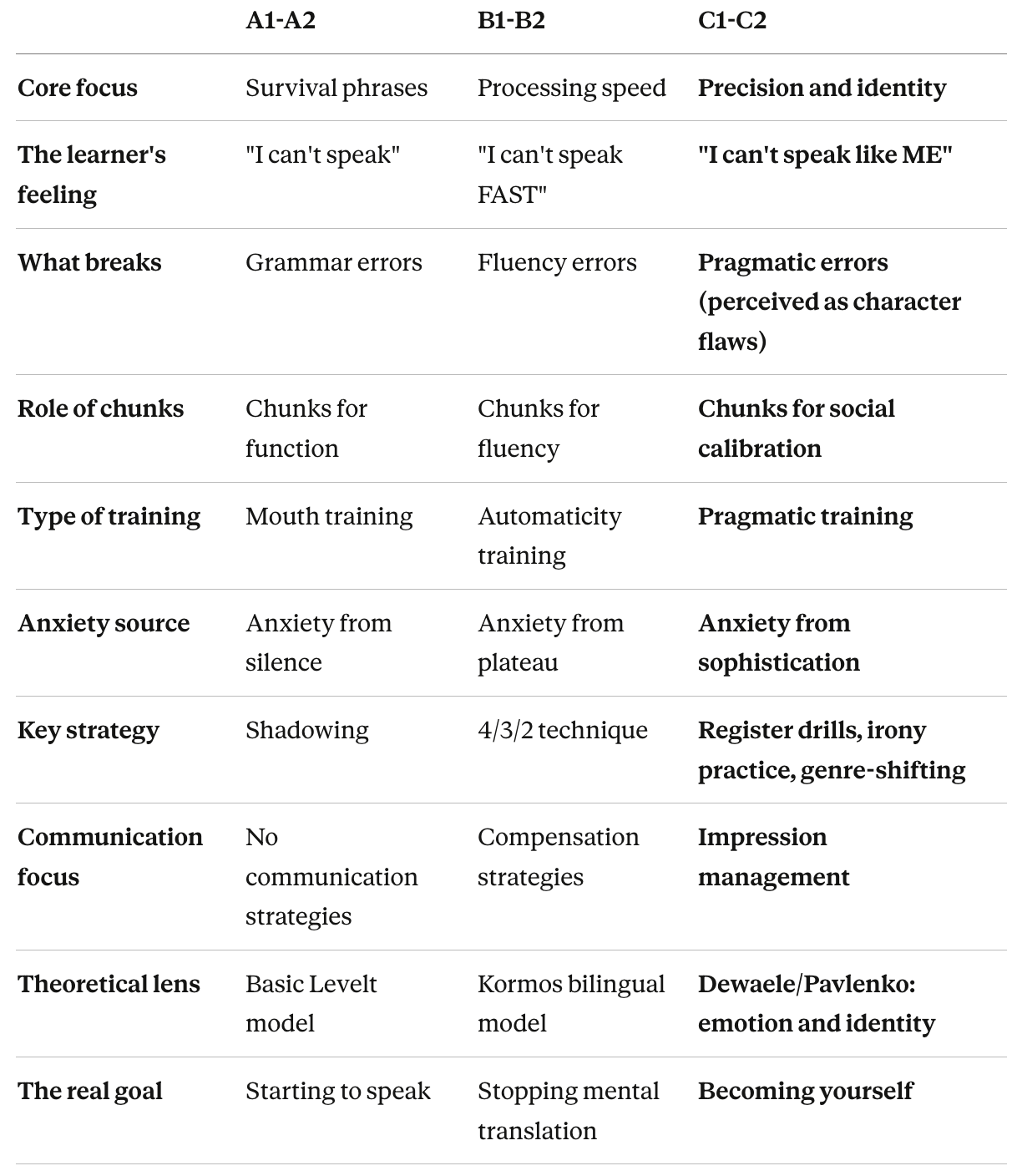
Before we look at what goes wrong at C1-C2, it helps to understand how speaking challenges transform as proficiency grows.
If you have been following this series, you know that A1-A2 learners face one set of problems (see this article).

And B1-B2 learners face a completely different set of challenges (see below).

The challenge does not simply get “harder.”
It changes in nature.
At the beginner level (A1-A2), speaking is a survival exercise. The brain is assembling every sentence from raw parts, word by word, with the first language doing most of the structural work behind the scenes.
I wrote about this in detail in my paid guide to beginner speaking, and I gave you a full system with strategies.

At the intermediate level (B1-B2), the problem shifts from assembly to speed.
The grammar is largely in place, but it operates too slowly for real-time conversation. Hilton (2008) showed that 78% of intermediate speakers’ longest hesitations were due to vocabulary retrieval problems, not gaps in grammar. The words exist in memory. They simply will not arrive fast enough.
My B1-B2 speaking system addressed this with strategies for automatizing known language through time-pressured practice, chunk-building, and spoken-grammar training.

At the advanced level (C1-C2), something fundamentally different happens.
Speed is no longer the primary issue. You can speak fluently enough to hold any conversation. But the quality of that speech, its precision, its social calibration, its emotional range, remains visibly (or rather, audibly) different from a proficient speaker who grew up in the language.
The shift across levels is not gradual. It is qualitative. What breaks, where it breaks, and what "better" even means changes completely at each stage.
How speaking difficulty transforms
10 Reasons Advanced Speakers Still Sound “Off.”
Reason 1: Your collocations are wrong, and nobody tells you.
You know the word “heavy.” You know the word “rain.” But do you say “heavy rain” or “strong rain”? Both make sense. Only one sounds natural.
Nesselhauf (2003) found that even advanced learners produced collocational errors in roughly 25% of their verb-noun combinations. They say “make a decision” correctly, but then say “do a mistake” instead of “make a mistake.” They write “give attention” instead of “pay attention.” Each individual error is small. The accumulated effect is that something sounds permanently, vaguely off.
Crossley, Salsbury, and McNamara (2015) confirmed that collocational accuracy is one of the strongest diagnostic markers of advanced proficiency. It predicts how “natural” a speaker sounds more reliably than grammatical accuracy or vocabulary size. Yet most language courses never teach collocations explicitly. You are left to absorb them through exposure, and exposure alone is not enough at this level.
Reason 2: Your oldest grammatical mistakes have fossilized.
There are errors you have been making for years. Articles in English. Preposition choices. Noun-phrase morphology. Verb aspect in Slavic languages. You made these errors at B1, you made them at B2, and you are still making them at C1.
This is fossilization: the point where errors stop developing because they no longer cause communication breakdowns.
Han (2004) documented how specific grammatical features stabilize in learner language and resist further change, even with continued exposure and practice.
Bartning, Lundell, and colleagues (2012) studied advanced L2 French speakers who had lived in France for up to 30 years and found that all three groups (short-term, medium-term, and long-term residents) still differed from native speakers in morphosyntactic accuracy.
The mechanism is simple. When an error does not cause a misunderstanding, your brain receives no signal to correct it. The neural pathway strengthens with each repetition. After years of reinforcement, the incorrect form feels natural. It has become part of your speaking identity.
Reason 3: You have one register for every situation.
You speak the same way to your manager, your friend, and a stranger at a bus stop. The same level of formality. The same vocabulary. The same hedging patterns. Your textbook taught you one version of the language, and that version is all you have.
The CEFR at C1 explicitly requires “appropriate style” across contexts. Carter and McCarthy (2006) demonstrated through corpus analysis that proficient speakers operate across distinct registers, adjusting vocabulary, sentence structure, directness, and even grammar depending on the situation. “I would be grateful if you could” and “Hey, could you just” are not different sentences expressing the same request. They are different social acts. Choosing the wrong one is not a grammatical error. It is a social error, and people attribute it to personality, not to language.
Reason 4: Your intonation carries information, but not meaning.
Your pronunciation is clear. People understand every word you say. But your intonation pattern is flat: it signals information without signaling attitude, irony, emphasis, or social warmth.
Saito (2020) found that at advanced levels, further gains in perceived proficiency come primarily from improvements in prosody and lexical sophistication, not from grammar.
Kang, Kermad, and Taguchi (2021) introduced the concept of pragma-prosodic competence: the ability to use pitch, stress, rhythm, and pausing to convey pragmatic meaning.
Consider the sentence “I didn’t say he stole the money.” Depending on which word you stress, this sentence has seven different meanings. That kind of prosodic control is what separates speech that is understood from speech that persuades, moves, and connects.
Derwing and Munro (2015) made the crucial distinction between accentedness (how different you sound from a native speaker), comprehensibility (how easy you are to understand), and intelligibility (how much of what you say is actually understood).
Advanced speakers are typically highly intelligible but may still score low on comprehensibility because their prosodic patterns do not match the listener’s expectations for how meaning should sound.
Reason 5: You speak in sentences, not in discourse.
At B2, you learned to produce sentences. At C1, the challenge shifts to producing coherent stretches of connected speech: telling a story with a narrative arc, building an argument with logical progression, and managing topic transitions without losing the thread.
The CEFR at C2 requires the speaker to “interweave his/her contribution into the joint discourse with fully natural turn-taking, referencing, and allusion-making.”
This means entering a conversation at the right moment, holding the floor without dominating, redirecting the topic gracefully, and exiting a point before it becomes repetitive.
Hughes and Reed (2017) showed that discourse management is a distinct competence from sentence-level accuracy, one that requires its own training.
Young (2011) demonstrated that interactional competence (knowing how to co-construct conversation with others) develops separately from linguistic competence. You can have perfect grammar and still be a clumsy conversationalist if you have never practiced the architecture of extended talk.
Reason 6: Your pragmatic calibration is off, and people blame your character.
Thomas (1983) drew a distinction that every advanced speaker needs to understand: pragmalinguistic failure versus sociopragmatic failure. Pragmalinguistic failure means you chose the wrong words for your intention. You wanted to be polite, but the phrase you chose was too direct. This is correctable and usually recognized as a language issue.
Sociopragmatic failure is worse. It means your judgment of the social situation was wrong. You were too familiar with someone you should have been formal with. You made a joke that crossed a cultural boundary you did not know existed. You gave feedback that was honest by the standards of your first culture but bruising by the standards of your second.
The problem with sociopragmatic failure is that listeners do not attribute it to language. They attribute it to you. “She’s too blunt.” “He’s a bit rude.” “She doesn’t read the room.” Roever (2021) showed that even at C1, many speakers never develop certain pragmatic markers. For example, many advanced English speakers never learn to use “well” as a prefatory particle before a disagreement, a hedging device that signals “I’m about to say something you might not want to hear.” Without it, the disagreement arrives unannounced, and the listener braces.
Reason 7: Your thinking is still formatted in your first language.
Wang and Wei (2022) introduced the concept of “thinking-for-speaking” in bilingual cognition: the idea that when you prepare to speak, your brain does not simply translate words. It formats entire concepts according to the cognitive patterns of whichever language is doing the underlying work.
At C1-C2, your formulator may be operating in L2, but your conceptualizer (the component that decides what to say and how to frame it before any words are selected) often still works in L1.
This means the ideas themselves arrive pre-shaped by your first language’s categories: how it handles time, motion, causality, and spatial relationships. The result is speech that is grammatically flawless but conceptually marked.
A Russian speaker might frame a narrative differently from an English speaker, not because of vocabulary limitations but because Russian organizes narrative events differently at the conceptual level.
This is one of the deepest challenges at C1-C2. It requires not just learning new words but restructuring how you think before you speak.
Reason 8: Nobody corrects you anymore.
At A1, every conversation partner becomes an informal teacher. They slow down, repeat, rephrase, and gently correct. At B1, teachers mark your errors in red. At B2, examiners score your accuracy.
At C1, you are socially competent enough that corrections feel rude. Your conversation partners understand you perfectly. They are not going to stop a pleasant dinner to say, “Actually, we say ‘heavy rain,’ not ‘strong rain.’” The social politeness that makes advanced conversation enjoyable is the same force that shields your errors from correction.
This creates a paradox. The level where precision matters most is the level where feedback disappears. The errors that need the most targeted attention are the errors that receive the least. Without deliberate strategies to generate your own feedback (through recording, transcription, and targeted analysis), fossilization is not just possible. It is inevitable.
Reason 9: You monitor for errors, not for effect.
Levelt’s (1989) model of speech production includes a self-monitoring component: a system that checks your output as it is being produced. At lower levels, this monitor is focused on errors.
Am I using the right tense? Is my word order correct? Did I pronounce that vowel properly?
At C1-C2, the monitoring task needs to shift.
The question is no longer “Is this correct?” but “Is this effective?” Am I hedging enough for this context? Is my tone matching my intention? Am I being too formal or too casual? Is this story landing the way I want it to?
Kormos (2006) showed that this shift from accuracy monitoring to effect monitoring is one of the cognitive hallmarks of advanced speaking. It requires freeing up attentional resources from grammar checking (which should be largely automatic by now) and redirecting them toward pragmatic and discourse-level awareness. Many advanced speakers never make this shift because they were trained in educational systems that rewarded accuracy above all else.
Reason 10: Your self-expression has shrunk to fit your language.
This is perhaps the most insidious problem.
Over years of speaking a second language, many advanced speakers unconsciously narrow their self-expression to match what they can say comfortably. They stop trying to be funny because timing is hard. They avoid complex arguments because the discourse management is exhausting. They choose simpler opinions because they lack the hedging tools to express nuanced ones.
Dewaele (2016) surveyed over 2,000 multilingual speakers and found that more than 60% reported feeling like a different person in their second language. This was not linked to proficiency level. Even highly proficient speakers reported feeling less witty, less warm, less themselves. The cognitive and social demands of advanced L2 speech consume resources that in the first language would be available for personality, creativity, and spontaneity.
The result is a gradual, often unnoticed retreat into a simplified version of yourself. You are not less intelligent or less interesting in your second language. You are operating with less bandwidth. And unless you target the specific skills that consume that bandwidth (the ten problems listed above), the simplification persists.
5 Strategies to Start Closing the Gap
The paid guide that accompanies this article (Thursday’s post, April 9, 2026) contains 20+ strategies organized into seven training pillars (collocations, defossilization, register, discourse management, prosody, and pragmatics), a complete 30-day program, 25 AI prompts for advanced speaking practice, and a downloadable PDF kit. Below are five strategies you can start with this week.
Strategy 1: Record yourself and transcribe the evidence.
This is the single most powerful diagnostic tool for advanced speakers, and it costs nothing.
Record yourself speaking for two to three minutes on any topic. A story about your weekend, an opinion about something you read, a summary of a meeting. Then transcribe what you actually said, word for word. Not what you meant to say. What came out.
Read the transcription and mark three things: collocational errors (word combinations that sound slightly wrong), grammar patterns you recognize as fossilized (errors you have been making for years), and moments where you simplified or avoided something because the precise expression would not come.
AI tools like ChatGPT, Claude, or Whisper can help you transcribe and analyze your speech. Paste your transcription into an AI tool and ask it to identify unnatural collocations, repeated grammar errors, and moments where a proficient speaker would have phrased something differently. This gives you a personalized error profile, a map of your specific weak spots. In Thursday’s paid guide, I will show you exactly how to use AI for this kind of targeted speaking analysis, with copy-paste prompts designed for C1-C2 learners.
Strategy 2: Build a personal collocation audit.
Take a topic you talk about frequently (your job, your research, your hobbies) and write down 20 sentences you commonly say about that topic. Then check each sentence against a collocation dictionary or corpus tool like the English Collocations in Use series, OZDIC.com, or the COCA corpus.
You will find that some of your most frequently used word combinations are slightly off. “Strong coffee” is correct, but “strong tea” should be “strong tea” (in English, both work, but in many other languages, the collocation patterns differ in unexpected ways). The goal is not to memorize a list. It is to identify the specific collocations in your personal speaking territory that need correction.
Strategy 3: Practice the same message in three registers.
Choose something you need to communicate regularly. A request. An opinion. A piece of feedback. Then write it out in three different registers: formal, neutral, and casual.
For example, if you need to disagree with a colleague’s idea:
Formal: “I appreciate the reasoning behind that approach, and I wonder whether we might also consider an alternative perspective.”
Neutral: “I see your point, but I think there might be another way to look at this.”
Casual: “Yeah, I get that, but I’m not totally sold on it. What if we tried something different?”
Practice saying all three versions aloud. Notice how your vocabulary, hedging, sentence length, and intonation change across registers. Most advanced speakers can write these three versions but cannot produce them spontaneously in conversation. The gap between written register awareness and spoken register production is where the practice needs to happen.
Strategy 4: Shadow for prosody, not pronunciation.
At A1-B2, shadowing (repeating speech you hear in real time) targets pronunciation and fluency. At C1-C2, the goal shifts. You are no longer trying to produce the sounds correctly. You are trying to reproduce the music: the pitch contours, the stress patterns, the rhythm of emphasis and de-emphasis that carry meaning.
Choose a speaker whose style you admire (a podcast host, a TED speaker, a news anchor, a character in a drama) and shadow 60 seconds of their speech daily. Focus specifically on where they speed up and slow down, which words they stress and which they reduce, and how their pitch rises and falls to signal questions, emphasis, irony, or uncertainty.
This is not about eliminating your accent. It is about expanding your prosodic range so that your intonation can carry the pragmatic meaning you intend.
Strategy 5: Run a “too direct / too indirect” calibration exercise.
Take a common social situation: declining an invitation, giving negative feedback, asking for a favor, or disagreeing politely. Write your natural response, the one you would actually produce in a real-time conversation.
Then write two extreme versions: one that is too direct (blunt, socially risky) and one that is too indirect (so hedged it loses the message). Now write a calibrated version that balances clarity with social appropriateness.
Too direct: “No, I can’t come. I don’t want to.”
Too indirect: “Oh, that sounds lovely, I would absolutely love to, but unfortunately, I think there might be a small possibility that I could perhaps have something else happening around that time, but I’m not entirely sure yet...”
Calibrated: “I’d love to, but I already have plans that evening. Next time, definitely.”
This exercise trains pragmatic calibration: the ability to adjust your level of directness to the social context. Most advanced speakers default to either being too direct (common in speakers whose L1 has a more direct communication style) or being too indirect (common in speakers who overcorrected after receiving feedback about being blunt).
The paid guide includes 30 pragmatic calibration scenarios across ten different social situations, with model responses at each calibration level.
What Comes on Thursday
The paid post that follows this article is the complete C1-C2 speaking system: seven training pillars, each with a full protocol of strategies.
The guide also includes a 30-day program, 25 AI prompts designed specifically for C1-C2 practice, a self-assessment, a progress tracker, and a downloadable PDF kit you can use as a standalone training manual.
Every article and PDF guide here takes weeks of research, writing, and rewriting to turn dense science into something you can use tonight. I’m one person doing this work with care. Upgrade to paid to get full access to everything I create and help me keep building it.
I’m curious, which of these problems do you recognize in your own speaking right now?
And if you have a friend or colleague who is fluent but frustrated, send them this article and share the publication. It might explain what they’ve been feeling for years.
References
Bartning, I., Forsberg Lundell, F., & Hancock, V. (2012). On the role of linguistic contextual factors for morphosyntactic stabilization in high-level L2 speakers. Studies in Second Language Acquisition, 34(2), 243–267.
Carter, R., & McCarthy, M. (2006). Cambridge grammar of English: A comprehensive guide. Cambridge University Press.
Crossley, S. A., Salsbury, T., & McNamara, D. S. (2015). Assessing lexical proficiency using analytic ratings: A case for collocation accuracy. Applied Linguistics, 36(5), 570–590.
Dewaele, J.-M. (2016). Why do so many bi- and multilinguals feel different when switching languages? International Journal of Multilingualism, 13(1), 92–105.
Derwing, T. M., & Munro, M. J. (2015). Pronunciation fundamentals: Evidence-based perspectives for L2 teaching and research. John Benjamins.
Han, Z.-H. (2004). Fossilization in adult second language acquisition. Multilingual Matters.
Hilton, H. (2008). The link between vocabulary knowledge and spoken L2 fluency. Language Learning Journal, 36(2), 153–166.
House, J. (1996). Developing pragmatic fluency in English as a foreign language: Routines and metapragmatic awareness. Studies in Second Language Acquisition, 18(2), 225–252.
Hughes, R., & Reed, B. S. (2017). Teaching and researching speaking (3rd ed.). Routledge.
Kang, O., Kermad, A., & Taguchi, N. (2021). Pragma-prosodic competence in L2 speech. Studies in Second Language Acquisition, 43(5), 1111–1134.
Kormos, J. (2006). Speech production and second language acquisition. Lawrence Erlbaum Associates.
Levelt, W. J. M. (1989). Speaking: From intention to articulation. MIT Press.
Nesselhauf, N. (2003). The use of collocations by advanced learners of English and some implications for teaching. Applied Linguistics, 24(2), 223–242.
Roever, C. (2021). Teaching and testing second language pragmatics and interaction. Routledge.
Saito, K. (2020). Multi- or single-word units? The role of collocation use in comprehensible and nativelike L2 speech. Language Learning, 70(2), 405–436.
Taguchi, N. (2019). The Routledge handbook of second language acquisition and pragmatics. Routledge.
Thomas, J. (1983). Cross-cultural pragmatic failure. Applied Linguistics, 4(2), 91–112.
Wang, Y., & Wei, L. (2022). Thinking and speaking in a second language. Cambridge University Press.
Young, R. F. (2011). Interactional competence in language learning, teaching, and testing. In E. Hinkel (Ed.), Handbook of research in second language teaching and learning (Vol. 2, pp. 426–443). Routledge.
This is brilliant, very helpful advice!
After 10 years in the US, my English is technically "fluent" but I still get caught sounding too formal in casual conversations. Meanwhile my American friends who took French for 6 years can't order a coffee in Paris. The gap between C1 on paper and actually sounding natural is wildly underestimated.