
The 30-Day Foreign-Language Journaling System
A science-informed month of writing, feedback, retrieval, and increasingly precise expression


For the last three articles on journaling, we have been building this system piece by piece.
We started with why and how to journal in another language.
Then we explored eight different journaling techniques, from Morning Pages and expressive writing to dialogue and voice journals.
In the previous article, we looked at what happens after you write: how to compare your language with feedback, understand what changed, rewrite the entry, retrieve useful language later, and bring it back into new writing and speaking.
Now I want to put all of that into one complete month of practice.
Because there is a big difference between knowing that journaling can help your language and opening your notebook and knowing exactly what to do.
This article gives you that structure.
Over 30 days, you will practise the major things we actually need language for: telling stories, describing precisely, explaining, comparing, expressing opinions, disagreeing, reconstructing conversations, reflecting, imagining, adjusting register, and developing a more individual voice.
You will not spend thirty days writing variations of:
Today I worked. I was tired. The weather was bad.
And you will not spend thirty days correcting every sentence.
Instead, the month follows a deliberate progression:
CONTROL → PRECISION → RANGE → INTEGRATION
You begin by finding out what you can currently produce independently. Then you work on expressing your meaning more precisely. Next, you expand the range of language and communicative functions you can use. Finally, you bring those pieces together and examine what has actually become more available to you.
Throughout the month, you will use the journaling techniques from the earlier article for different purposes. Some days are personal diary entries. Some use prompts. Some are short deliberate writing tasks. Some involve dialogue, fragments, or voice recording. Selected entries go through the deeper learning cycle:
COMPARE → UNDERSTAND → REWRITE → RETRIEVE → REUSE
Every week, you also look for recurring patterns in your own production so that your journal gradually creates something much more valuable than a pile of corrected pages:
Your personal language syllabus.
By Day 30, you should be able to answer questions such as:
What grammatical problems keep returning in my writing?
Which vocabulary do I understand but rarely produce?
Which thoughts become simpler when I try to express them in this language?
Which communicative situations are still difficult for me?
Has my language become more precise, connected, and flexible?
What should I work on next?
This is a science-informed pedagogical system, rather than a thirty-day programme that has itself been experimentally tested. Its design brings together research on second-language output, written corrective feedback and revision, retrieval practice, reflective language use, and communicative competence. I will explain the reasoning as we go without turning the article into a literature review.
I also made the practical companion for you
Attached to this article is The 30-Day Foreign-Language Journaling Workbook (52 pages).
It takes the methodology out of the article and puts it into a day-by-day working format.
Inside, you will find all 30 tasks, adaptations for A1–A2, B1–B2, and C1–C2, daily language lenses, feedback and rewrite pages, retrieval exercises, weekly diagnostic reviews, recurring-pattern trackers, a Personal Syllabus builder, and the final Day 1 versus Day 29 comparison.
You do not have to finish this article and then design your own programme from it.
I have already built the programme.
And I created something much larger for Founding Members
Alongside the workbook, I created a separate book:
365 Foreign-Language Journaling Prompts (205 pages)
Release Your Creativity, Expand Your Language, and Develop Your Personal Voice
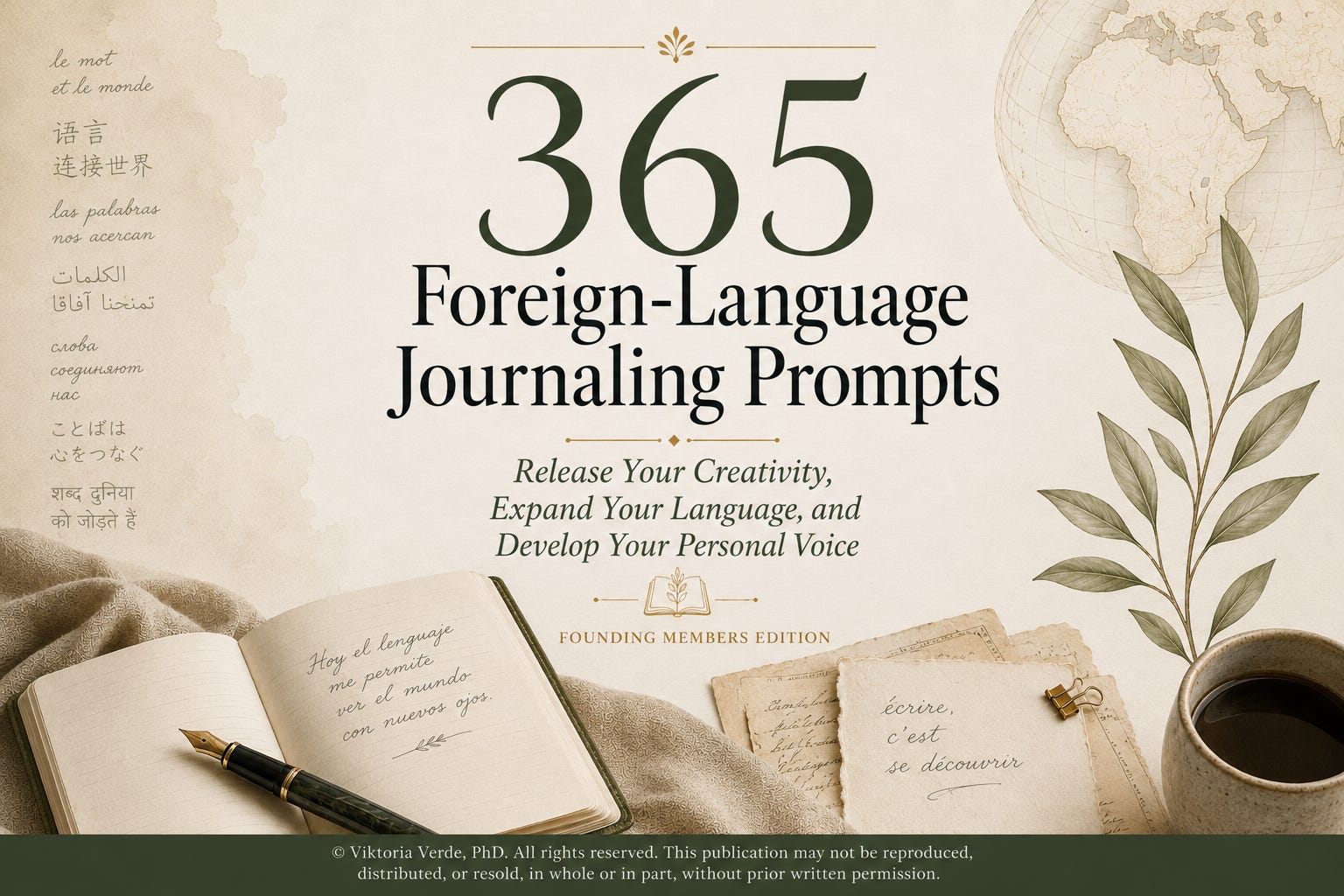
These are not one-line questions. Each prompt includes guidance on developing the entry, ideas to include, a possible opening, a language lens, level guidance, and an optional challenge.
The book moves through everyday life, memory, identity, relationships, places, language learning, imagination, argument, emotion, the future, observation, and personal voice.
I created it specifically for Founding Members as a thank-you for supporting my work at the highest membership level.
Founding Membership includes everything in the regular paid subscription, together with my personalized language-learning planning and additional resources created specifically for Founding Members.
So there are three layers here:
This article explains the complete system and the reasoning behind it.
The paid workbook gives you the exact 30-day programme to follow.
The Founding Member book gives you 365 developed prompts for continuing the practice long after the first month.
If you have wanted to start journaling in your target language but were unsure what to write, how much to write, what to correct, what to look for at your level, and how to turn those pages into actual language learning, this is where all of those pieces come together.
Every article I publish draws on my expertise in second language acquisition and a lifetime of learning and teaching languages. I turn that knowledge and research into clear, practical systems you can use immediately. Upgrade to paid to support my work and unlock the full library of articles, guides, and resources. Thank you!
P.S. If this email is clipped in your mailbox, click “View entire message” or open the article directly in Substack, either in the app or in your web browser, to read the full post and access the workbooks.