
Speaking Begins Where Solo Study Ends
Why a real person beats the books and how to use tutoring hours like you mean it.


I have a PhD in applied linguistics and three certificates that say I am qualified to teach languages. In every article I publish and to every student in my classroom, I preach the same thing. You learn to speak a language by speaking it, with other people. My whole career stands on that one sentence.
For years, in my own learning, I did the exact opposite.
I taught myself English at 16, alone, with books, and it worked, so I never stopped. Books were safe. A grammar table never raised an eyebrow when I fumbled a verb. A word list never sighed and switched to my own language out of pity. So I hid in them. I told myself I was laying a foundation, that once the grammar was firm and the vocabulary deep, I would finally speak to a real person.
Until then, why invite the heat in my cheeks, the mumbling, the small death of being misunderstood?
The excuse held until a train station situation in Gothenburg, Sweden.
I had taught myself Swedish back in Poland without any classroom courses or teachers. Less than a year later, I won a scholarship from the Swedish Institute, which took me to Gothenburg for a full summer course at a boarding school.
I stepped up to the ticket counter, sure of every word. I said my line. The man looked at me for one slow second and answered in English.
My heart sank. Maybe he misheard me. Maybe my sentence was incomprehensible. It made no difference. My patient, solitary work suddenly lost meaning, and one sentence to one stranger slid straight to the floor between us. On paper, my Swedish shone. In the one place it was built for, it was useless.
Now, when I feel the old tug to bury myself in a book and put speaking off a little longer, I stop. I still love the books. I read them every day. But I no longer let them stand guard in front of my mouth. I speak from the first day and lay the foundation alongside it, the way I should have all along.
I learned it too late, and you do not have to. The wall is not built of missing words. You already understand far more than you can say. What you lack is a person. We learn a language to reach other people, and reaching other people is the only thing that ever makes one take root.
My crutch was a book. Yours might be an app, or one of the AI tutors that promise to chat with you at any hour and never run out of patience. They help, more than I once expected, with drilling words, catching slips, and keeping you company between lessons. Use them. Just do not mistake them for the thing itself. No screen has ever grown a face with human thinking, feelings, and emotions, and the part that turns what you know into speech still needs a human on the other side.
So let me do three things here.
First, show you why speaking with real people sits at the dead center of learning a language.
Second, walk you through how I practice on Preply and run my own tutoring hours.
Third, hand you the habits that keep your speaking alive, both with a tutor and without one.
Your Brain Is Waiting for a Person
The research is not subtle about this, and I say that as someone who spent years pretending otherwise. My argument comes down to six findings.
1. Input alone gets you stuck
For a long time, the field believed in Krashen. Soak up enough input, enough listening and reading, and speech would bloom on its own (Krashen, 1985).
It was a lovely idea.
It was wrong.
Long combed through decades of evidence and found that input-only learners understand mountains and produce molehills (Long, 2014).
They harden in a spot Selinker named. Fossilization, where your second language sets like concrete, mistakes and all, no matter how much more you pour in (Selinker, 1972).
2. Speaking is the engine
What cracks the concrete is your own voice.
Swain watched French-immersion children in Canada who had soaked in input for years and still spoke clumsily, and saw that understanding was never the whole job.
Speaking does what listening cannot. It makes you feel the raw gap between the thought in your head and the words in your mouth, and that ache is what drags you forward (Swain, 1985).
A second person doubles it. When a conversation trips and the two of you scramble to fix it, rephrasing, asking “sorry, what?”, trying again, Long showed that the patching teaches more than any flawless recording (Long, 1996). The fumbling is the lesson.
3. A person fits the lesson to you
A person aims for the difficulty.
Vygotsky called it the zone of proximal development, the thin ledge between what you can do alone and what you can do with a hand under your elbow (Vygotsky, 1978).
A good tutor keeps you balanced right there. An app cannot find the ledge because it shifts every week and sits somewhere different for every learner. A person also hears what you cannot.
Schmidt argued you never absorb a feature of a language until you consciously notice it, so a mistake nobody catches can echo for a decade (Schmidt, 1990).
But watch for one trap.
Lyster and Ranta sat through hundreds of classroom corrections and found the gentlest kind, the soft echo of your sentence handed back in correct form, was the most common and the most useless, because students mistook it for a nod of approval and sailed on (Lyster & Ranta, 1997).
So ask to be corrected out loud, in plain words.
4. Your brain needs a human in the room
Then there is the most interesting evidence of all.
Researchers gave nine-month-old American babies the same Mandarin lessons in two ways: some from a real person in the room, some from a screen showing the same content. The babies with humans learned to hear Mandarin sounds. The babies with the screen learned nothing at all (Kuhl, Tsao, & Liu, 2003).
Same words, same hours. The human body in the room was the whole difference.
Feeling is part of it too. Schumann showed that the brain reads every moment for safety or danger, and that reading decides whether new connections form (Schumann, 1997).
Warmth opens the door. Fear bolts it.
5. The gap between knowing and saying
MacIntyre and colleagues found that the willingness to communicate is its own trait, almost unhooked from how much you actually know, which is why a learner who is fluent on paper can still seize up (MacIntyre, Clément, Dörnyei, & Noels, 1998).
Dakowska traced the spiral that follows, where dread eats the attention you need, the words come out worse, and the dread digs in deeper (Dakowska, 2005).
I lived in that spiral for years. A warm, patient human is the one who finally hauls you out.
6. And a language is for people anyway
Under all of it sits one plain truth. Cook argued the goal was never to counterfeit a native speaker, an ideal recent work calls close to a fairy tale, but to become a real user of the language, someone who reaches other people with it (Cook, 1999; Dewaele, Bak, & Ortega, 2023).
The point is human. So the method has to be human too.
Put it all together, and the science is blunt. Speaking with a real person does what solo study never can.
It pushes you to produce, not just understand.
It repairs your mistakes in the moment.
It keeps you balanced just past your limit.
It catches the errors you cannot hear.
It gives your brain the human presence and warmth it needs.
It turns what you already know into speech you can use.
Four People Who Taught Me What No Book Could
Of my eight languages, two came with childhood, Russian and Belarusian. The other six I built as an adult, and the four people who taught me the hardest part of each, the speaking itself, I found on Preply.
I have studied Spanish there since 2021, and this year, dusting off my Italian and German, I went straight to tutors in the first week, because I no longer confuse what feels comfortable with what works.

My 216 hours of learning on Preply
Somewhere along the line, the platform told me I had spent 216 hours in lessons, almost none of them with one teacher. Four tutors in particular built my Spanish and Italian between them, and the lovely part is that no two of them ever did the same job.
Linda, and the lesson that turned into a friendship
Linda, 60 years old, one of my Spanish tutors, is from Venezuela, and she is the reason I understand what it means to learn a language with someone instead of from them.
We have met for years, and at some point, the lessons stopped being only lessons.
She has told me about life under Venezuela’s dictatorship, about the collapse that has driven nearly eight million people out of the country, her own daughters among them, now in the United States and still waiting on their papers. She lived through the floods that swallowed the town of Las Tejerías in 2022. She tells me these things without a flicker of self-pity, often smiling, though the pain sits just under every word, and she would never let it tip into complaint.
So I listen.
That is most of what those hours are. I listen, and I hand her my own life back, the births of my two children, my daughter who is five now, and my son who is one.
Our time together is half Spanish lesson and half something closer to therapy, for both of us.
She is also the one who most tenderly built my grammar and vocabulary, jotting down every word I reached for and missed, saving it, setting it as homework, so the list sat waiting whenever I revised at home or in the last few minutes before her face appeared on the screen.
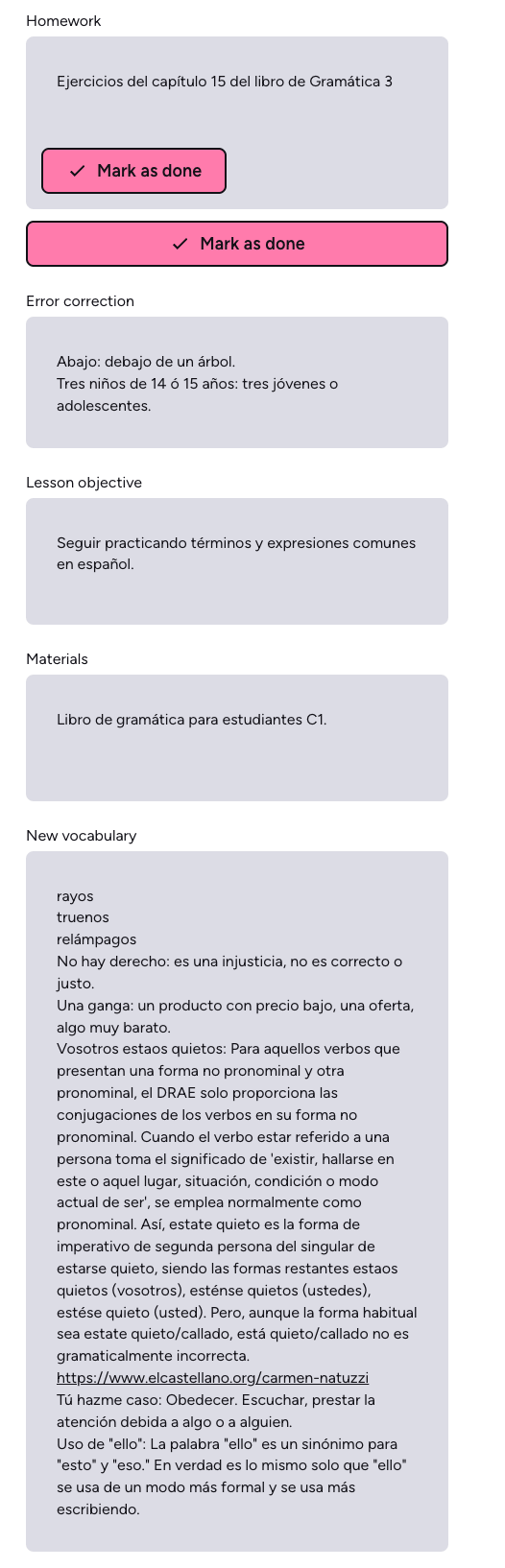
Screenshot: My lesson view showing the error corrections and saved homework
Luna, and the open water
Luna, another of my Spanish tutors, is from Argentina, young and seriously gifted, and her job is to pull me upward.
With her, there is no drifting. She hands me real literature and makes me wring meaning out of it, has me say one sentence five different ways, chase down the exact synonym, follow a heated argument, even crack the slang of Argentine influencers. She shares her screen and drops the clips and texts straight into the lesson as files, so they stay mine long after the hour ends. She holds me just past the edge of what I can comfortably manage, which is the only place that ever grows.
One afternoon, she had me reading Metamorfosis, by the Argentine writer María Negroni.
“Say it back to me in your own words, paraphrase”, she said, “no dictionary, right now.”
So I did, out loud, scrambling for words while my mouth was already moving. Negroni’s line “Este será el diario de la dispersión” came back to me as “Este será el registro de mis pensamientos que aparecen de forma desordenada,” the record of my thoughts as they surface, out of order.
It was the most alive my Spanish had felt in months. That is the whole point of her. I was not recognizing a word on a flashcard; I was making the language on the spot, building each sentence while thinking and speaking at once, and feeling exactly where it ran short.
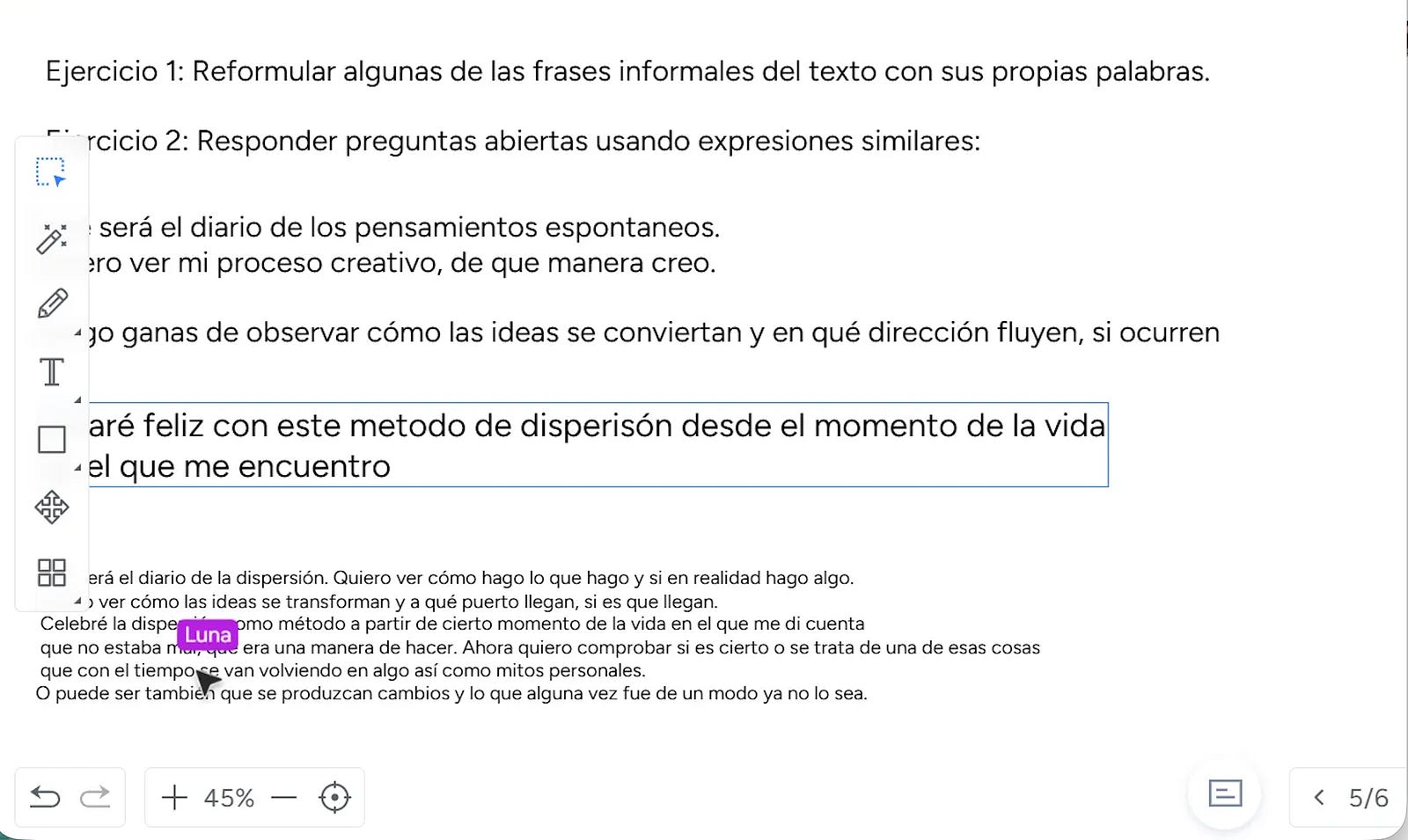
Screenshot: my lesson with Luna, paraphrasing María Negroni’s Metamorfosis
David, and the lane markers
David, who also teaches me Spanish, is from Bogotá, and with him I get the thing my book-loving heart adores most: structure.
We prepared for the Spanish DELE exam together, grinding through past papers and targeted writing, listening, and discussion.
He gives one clean instruction, then leans back and lets me carry the hour.
The platform keeps a running tally of how long each of us talks, and in David’s lessons my share is always the highest, eighty or ninety percent, which is the entire point.
Nicola, and the curriculum built for one
And Nicola, my Italian tutor, made the lessons mine. After every class, he built materials around exactly what I had tripped over, and sent them as PDFs, with homework, so each week opened precisely where the last one closed.
He let me run at the fast pace I love. I still have those files, a small private curriculum no app could have written, because no app knew me.
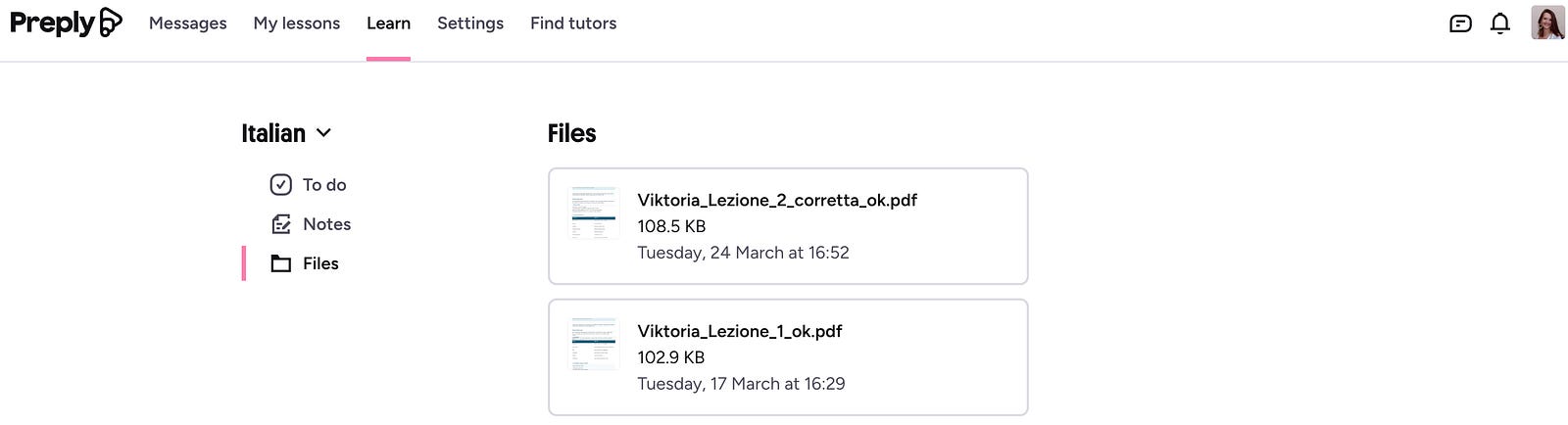
Screenshot: the Files page with the saved PDFs
Four countries, one education
I tried a few other tutors along the way and never clicked in the same way, and when that happened, I could simply transfer my leftover credits to the three I trusted and carry on.
These four I did click with, across four countries, several accents, two generations, each one handing me a different piece of the same education. One gave me a friendship. One pulled me higher. One gave me structure. One made it personal. Together, they were a whole, the rounded, complete teaching I could never have stitched out of any single course or any app.
The little tools around the lessons hold it all in place: the timer that shows how much I actually spoke, the vocabulary my tutors save for me to revise between classes, the files and PDFs I keep, the homework waiting when I log back in.
After all these years and hours, the place where I found these four people has come to feel less like a website and more like somewhere I belong.
How to Run a Lesson Like You Mean It
A tutoring hour can change you, or it can simply keep you company, and the whole difference lies in how you run it. Many people run it passively. They show up, they nod, they let the tutor do the driving. Sometimes it works fine; sometimes you feel you need to steer the lesson yourself.
After 216 hours, I can recommend these strategies to help you make the most of your tutoring sessions.
1. Do most of the talking
This is the one that matters most. You are there to produce the language, not to admire someone else producing it.
Aim to speak at least two-thirds of every hour.
Watch the speaking-time tracker, and speak up if your tutor drifts past the halfway mark.
Ask your tutor to keep explanations short and hand the floor back fast.
2. Tell your tutor how you want the time spent
Tutors are far more flexible than people expect, and a good one is glad to be told what you need. Steering the lesson is the single most useful thing you can do inside it.
Say plainly what you want, like “I want to speak most of the time,” or “push me on the past subjunctive.”
Ask for what scares you, not for what soothes you.
Tell them whether to let you sweat for a word or to feed it to you fast.
3. Give the hour a shape before it starts
Walk in with a plan, even a loose one, and you will stop wasting lessons. The shape I use is simple, and you are welcome to take it.
Open with five minutes of easy warm-up talk to loosen your tongue.
Spend the middle stretch, twenty or thirty minutes, speaking about something you prepared, a topic, a text, or an argument.
Save the end for the mistakes your tutor caught and the new words that surfaced.
Send the plan to your tutor beforehand so you both walk in ready.
4. Ask to be corrected out loud
The gentlest corrections slide straight past you, because they sound like agreement. So make the correction impossible to miss.
Ask your tutor to flag mistakes openly, not slip them back rephrased.
Have them write the important errors where your eyes can land on them.
Read that list before your next lesson.
5. Bring something real to talk about
Your brain holds on to language that carried real meaning and lets the filler go. So never arrive empty.
Bring an article that annoyed you, an opinion you want to test, or a knot from your week.
Choose what you actually care about, not textbook weather and weekends.
Send the material ahead if it needs to be read first.
6. Ask to be stretched
Growth lives just past the edge of what you can already do, so ask for the thing that is slightly too hard.
Ask for real texts to wrestle with, not the watered-down kind.
Have your tutor make you paraphrase, look up synonyms, and defend a view.
Treat any lesson that felt too easy as one to redesign.
7. Capture the new words, then revise them
The hour plants the words. The revision is what grows them.
Ask your tutor to save the new vocabulary and your repeated errors after each class.
Read them back aloud, in full sentences of your own, never as a flat list.
Do it in the spare minutes before the next lesson, or on the walk home.
8. Choose a person, not a profile
The relationship carries more of the work than you would expect, so spend a little time finding the right human.
Book a few trial lessons before you commit.
Pick the tutor you look forward to seeing, not the most decorated on paper.
If one does not fit, move your credits to another and carry on without guilt.
9. Keep speaking between the lessons
You cannot book a human for every waking hour, so bridge the gaps. None of this replaces a real lesson, but all of it keeps your mouth moving until the next one.
Narrate your morning out loud while the coffee brews.
Send a voice message instead of typing one.
Find a language exchange partner or a conversation club and actually use it.
Read your saved words back in sentences you invent on the spot.
None of these habits is complicated. Each simply lifts you out of the passenger seat and drops you behind the wheel of your own learning. Do them, and an ordinary hour with a tutor becomes the most useful thing in your week.
Why I Keep Choosing People and Preply
The first half of that answers itself by now. I practice with real people because everything above, the research and my own twenty years, says it is the only thing that truly works. As for why Preply, it comes down to a handful of things that have kept me there since 2021.
Over 100,000 tutors across 90 languages, from every country and accent you can think of.
Tutors at every price point, with a free trial before you ever commit.
Complete freedom to switch tutors and carry your credits with you.
A speaking-time tracker, your talk time against the teacher’s, shown as a percentage.
Vocabulary your tutor saves for you to revise.
Files and PDFs you can upload and keep.
Homework set between lessons.
AI that backs up the tutor rather than replacing her, with lesson summaries and speaking practice between classes.
None of these tools does the learning for me. They just make it easy to keep showing up for the part that does, the hour with a real person.
Final thoughts
Remember the version of me at that ticket counter, every word rehearsed, certain the books had done their job. The distance between that confidence and that silence is where most learners live for years, and it does not close by studying harder, downloading one more app, or waiting for an AI clever enough to stand in for a person.
It closes the way it always has, by sitting across from another human and trying, stumbling, being caught, and trying again, until one day the words simply arrive.
A language was never meant to be memorized in private.
It is the oldest bridge we have between one mind and another, and nobody has ever built a bridge from a single side. So keep the books. I still do. Just stop letting them stand in front of speaking.
Go and find your people. It really does take two.
Thank you for reading!
Tell us in the comments about your experience with online tutors.
Every article and PDF guide here takes weeks of research, writing, and rewriting to turn dense science into something clear you can use tonight. I’m one person doing this work with care. Upgrade to paid to get full access to everything I create and help me keep building it.
Want a truly personalized learning plan based on your level, goals, and how you actually learn? I design a clear, structured, science-based system tailored exclusively for you.
Consider becoming a Founding Member.
A note of thanks
This piece is a paid collaboration with Preply, and I feel genuinely grateful and honored to share it. Preply has been the platform I have personally used for years in my language-learning journey with tutors. This is the place where I built my speaking skills, found wonderful teachers, and experienced real progress. So writing about my authentic experience was pure joy. I’m happy to share the features, benefits, and small practical details that have made Preply such a meaningful part of my own learning life.
I’m also happy to share my referral link, which gives you 70% off your trial lesson. I receive a small Preply credit at no extra cost to you. It allows me to continue practicing my languages on this platform.
Thank you for reading and supporting my work.
References
Cook, V. (1999). Going beyond the native speaker in language teaching. TESOL Quarterly, 33(2), 185–209.
Dakowska, M. (2005). Teaching English as a foreign language: A guide for professionals. Wydawnictwo Naukowe PWN.
Dewaele, J.-M., Bak, T. H., & Ortega, L. (2023). Why the mythical “native speaker” has mud on its face. In N. Slavkov, S. Melo-Pfeifer, & N. Kerschhofer-Puhalo (Eds.), The changing face of the “native speaker” (pp. 23–43). De Gruyter Mouton.
Krashen, S. D. (1985). The input hypothesis: Issues and implications. Longman.
Kuhl, P. K., Tsao, F.-M., & Liu, H.-M. (2003). Foreign-language experience in infancy: Effects of short-term exposure and social interaction on phonetic learning. Proceedings of the National Academy of Sciences, 100(15), 9096–9101.
Long, M. H. (1996). The role of the linguistic environment in second language acquisition. In W. C. Ritchie & T. K. Bhatia (Eds.), Handbook of second language acquisition (pp. 413–468). Academic Press.
Long, M. H. (2014). Second language acquisition and task-based language teaching. Wiley-Blackwell.
Lyster, R., & Ranta, L. (1997). Corrective feedback and learner uptake: Negotiation of form in communicative classrooms. Studies in Second Language Acquisition, 19(1), 37–66.
MacIntyre, P. D., Clément, R., Dörnyei, Z., & Noels, K. A. (1998). Conceptualizing willingness to communicate in a L2: A situational model of L2 confidence and affiliation. The Modern Language Journal, 82(4), 545–562.
Schmidt, R. W. (1990). The role of consciousness in second language learning. Applied Linguistics, 11(2), 129–158.
Schumann, J. H. (1997). The neurobiology of affect in language. Blackwell.
Selinker, L. (1972). Interlanguage. IRAL – International Review of Applied Linguistics in Language Teaching, 10(3), 209–231.
Swain, M. (1985). Communicative competence: Some roles of comprehensible input and comprehensible output in its development. In S. Gass & C. Madden (Eds.), Input in second language acquisition (pp. 235–253). Newbury House.
Vygotsky, L. S. (1978). Mind in society: The development of higher psychological processes. Harvard University Press.
I took an immersion course where they corrected you by repeating the incorrect sentence but stopping at the error and letting you figure out the correction (assuming it was something we had already learned).
I found this to be an effective teaching method me
Is there a baseline of knowledge you recommend having before engaging with a tutor? When you're just starting out it seems like it'd be hard to go into a lesson trying to talk about something meaningful.